AI personalization, recommendation engines, and demand sensing fail on fragmented data. Infoverity delivers retail AI strategy and implementation, on the customer and product data foundation that makes it reliable.













Retail sits at the front line of enterprise AI. Personalization. AI-powered search. Demand sensing. Dynamic pricing. Every one of these use cases runs on a customer and product master the model can trust.
The next shift is already underway. Agentic commerce, AI agents that browse, compare, and purchase on behalf of customers, is becoming a reality. When an AI agent queries your product catalog, it reads structured attributes, validates against its buying criteria, and either converts or moves on. Retailers whose product data is structured, findable, and purchasable within agent platforms will capture that transaction. One retail client redirected more than $176K in annual data cleanup spend toward AI innovation after restructuring their product data foundation, and saw 25 to 40% improvement in AI model accuracy as a result. The first-mover window is the next 12 months.
Most retail AI programs stall on the same problems that will also block agentic commerce: duplicated customers across POS, loyalty, eCommerce, and CRM; fragmented product data across PIM, ERP, and supplier feeds. AI built on that foundation does not just underperform, it amplifies errors at scale, in front of customers. Infoverity solves both halves: retail AI strategy and deployment, on the governed customer and product data foundation that makes every channel reliable.

40%
of enterprise retail applications will embed AI agents by end of 2026, up from less than 5% in 2025. Inventory optimization, shelf management, and checkout automation are already running without human intervention. Source: Gartner via BizTech Magazine.
282%
is how fast AI implementation has surged in a single year. 35% of CIOs are working more closely with their CDO as a result. The technology is scaling. The leadership alignment isn't. Source: Salesforce CIO Trends
58%
of retailers are actively deploying AI. 42% are still planning. The difference isn't budget or technology. It's data readiness. The gap between leaders and laggards is a data problem, not an AI problem. Source: Snowflake Data Trends Retail & Consumer Goods
Most retail AI pilots stall when the data underneath them is not ready. Our AI Strategy and ROI Analysis identifies the use cases worth funding and maps a path to first value. Our AI Deployment service takes them live, and keeps them running, including on agentic commerce channels.
1,000+ enterprise data and AI projects, for 200+ clients globally, across 14+ years. Retail engagements run on the MDM, PIM, and modern data platforms our retail clients already use. We bring platform-independent advice when that is the right answer for the AI use case in scope.
Generative AI amplifies bad data at scale, and AI agents are even less forgiving, they query structured attributes directly and do not compensate for gaps. We deliver AI implementation and the master data, governance, and quality foundation that makes every model reliable. One partner, one delivery team, across the full AI lifecycle.
We are judged on real business results, not deliverables. Great Clips cut duplicate customer records by 30%. Today they run more than one million API calls per day at 300ms average response against a single trusted customer view. It powers marketing, analytics, compliance, and point-of-sale, with LLM-assisted merge processing on the master itself.
These are the questions we hear most from retail CDOs, IT directors, and data architects.

A customer 360 ready for AI does not require rebuilding everything at once. Our retail programs run in defined phases, starting with data strategy and a phased implementation roadmap. The master data management (MDM) workstream typically delivers a unified, AI-ready customer master alongside data governance and analytics workstreams, so marketing, eCommerce, and AI personalization models can begin consuming clean data while later phases continue.

AI applied to product search amplifies every gap and inaccuracy in your PIM. We build the product data foundation, on the PIM and MDM platforms best suited to your stack, so your AI works against a clean, enriched, governed product record before it ever reaches a customer touchpoint. The same foundation that fixes AI-powered search is what makes your product data structured, findable, and queryable by AI agents on agentic commerce channels.

Our AI Strategy and ROI Analysis service produces a tactical AI/ML roadmap with model recommendations, gap analysis, and ROI analysis including time-to-first-value metrics. You arrive at the board with a defensible AI business case, not a science project.

Customer data spread across POS, CRM, online, and marketing tools creates systemic duplication. Our MDM implementations consolidate those records into a single master and feed clean data back to every consuming system. Great Clips reduced duplicate customer record volume by 30% across 4,400+ locations and now runs LLM-assisted merge processing on the customer master.
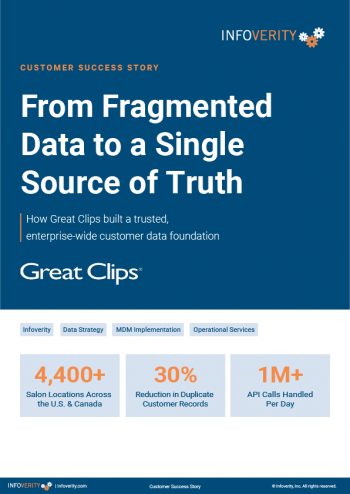
Infoverity led three consecutive phases: enterprise data strategy, full implementation of Informatica Customer 360 MDM SaaS, and ongoing operational services. The result is a single authoritative customer record: deduplicated, address-validated, CCPA-compliant, and delivered reliably to every system that depends on it. LLM-assisted processing now handles stylist merge feedback at scale, putting AI to work on the operational data quality that keeps the platform accurate day to day.
Six integrated capabilities. One firm that delivers all of them, so your AI investments don’t fall into the gap between a data team and an AI team.
Move from rule-based promotions to AI-driven, customer-specific content. On a governed customer and product master that keeps the model trustworthy at scale.
Forecast product demand, reduce stockouts, and cut excess inventory. Provide a 360-degree view of customers, products, and supply chains, on integrated order, product, and supplier data.
End-to-end AI lifecycle. AI Strategy and ROI Analysis (2 to 4 months, including 4 to 6 weeks to identify high-impact use cases). AI Design and Prototype (6 to 8 weeks). Full AI Deployment with API and integration development, performance optimization, and ongoing support and maintenance.
Consolidate customer data from POS, eCommerce, loyalty, and CRM into a single trusted record. The foundation of every customer-facing retail AI use case depends on.
Accelerate product onboarding. Enrich the digital shelf. Govern taxonomy so your product data is structured, findable, and purchasable, by AI-powered search, recommendation engines, and the AI agents that are becoming a key buying channel.
The governance, lineage, and quality framework that makes retail AI auditable, compliant under emerging AI regulation, and ready to scale beyond pilot.
Is our product data structured well enough for agentic commerce?
AI agents do not browse your catalog. They match against structured attributes and either find a qualifying product or move on. Retailers with fragmented product taxonomy will not surface in those results. We build the PIM and taxonomy governance foundation that puts your products in contention when AI agents become a key buying channel.
No obligation — a 30-minute conversation to understand where your AI and data strategy stands and where it could go.

